
If love is indeed a language, it is likely one with many dialects. The sort that emerges through the dialogues of a suspenseful dark comedy, with unexpected twists, turns and a meaningful catharsis, just like the one in Ludovica Rampoldi’s intriguing first feature film. It becomes audible through the characters themselves who masterfully carry all the definitions, but equally the ambiguity, sometimes the void behind words, behaviours, motives that remain untranslatable, in principle.
It becomes visible through the minimalistic aesthetics of enclosure, a unique and quite fitting style for a film crafted with the utmost care and attentiveness to introspective relationships. It becomes felt through intrigue mixed with joy, a sense of discovery and fulfilment when one encounters a new and mysterious word, behaviour, presence, person, attitude towards life and human relationships.
Ludovica Rampoldi, one of the most charismatic and acclaimed screenwriters of her generation,creates through A Brief Affair (2025) a kaleidoscopic cinematic expression; a unique love language dedicated to cinema, that is refined in its rawness and authentic, pure, in its stylisation. Rather than a straightforward love confession though, her dedication to cinema is expressed through a sophisticated language that develops, in my opinion, around iterations of liminal time. The time between something being expressed, or implied, and accessed by someone; the time between something being said but hanging, immersed in vagueness, untranslatability; the time between action being taken and its response becoming noticed; the time between nothing being said and consequences, or life, eventually happening; the time that was not supposed to be there, but it somehow emerged between people, nurturing the most unlikely relationships.
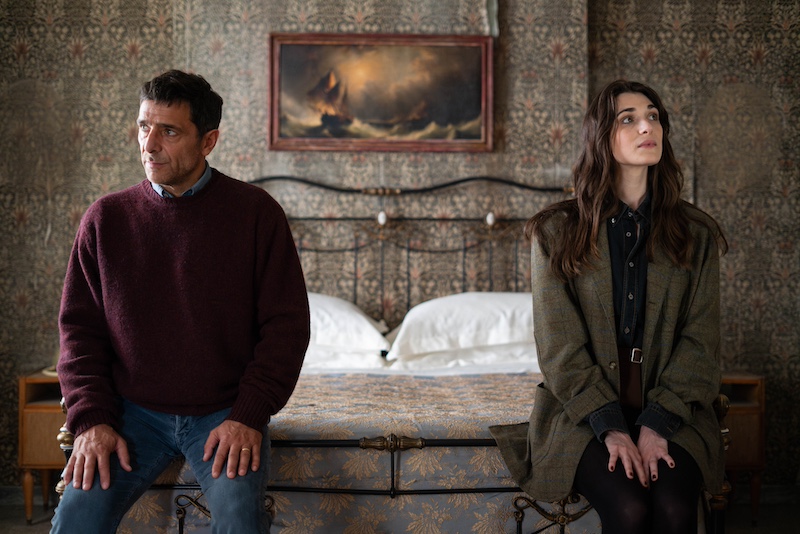
This experience of time however is neither linear nor transient. Rather, in Rampoldi’s cinema it holds space, it acquires texture expressed equally with volume and subtlety through appropriate cinematography and mise-en-scène. Small background details become interchangeable with major focal points in frames defining the plot, showing the type of life that has accumulated in a place and how it becomes disrupted at present. Surreptitious movements become prominent with appropriate lighting and camera angles, making an indelible mark on characters’ bodies, minds and their psyche. Strange sounds come together to form unknown words that uplift and exhilarate but equally distance, cut and hurt. Intriguingly compelling in their ambuguity, they lure Rampoldi’s characters in, in a quest for understanding. Instead of clarity however, they foreground their deeper engagement in a world of mystery that eventually leads each one to their own unconventional catharsis.
Lea meets Rocco on a Friday evening in a small, local bar in Rome. The attraction between them is undeniable and soon becomes too challenging to ignore. The two of them start a passionate extramarital affair, which becomes more intense and deep as time goes by. While true love seems to be in the air, Lea starts showing signs of obsessive behaviour. She shows up unexpectedly in locations where Rocco works and lives, intruding his personal space and dismantling any sense of quotidian equilibrium. She secretly follows and meets his wife Cecilia, and unbeknownst to him, she befriends her. While Lea seems to be invested in getting to know both and erode their sense of peace, her motive isn’t exactly to expose the affair or harm the couple. Rather, as it only becomes clear in the end, she is on a journey of revenge for her husband’s actions and role in this maze of relations. Slow burn, this suspenseful dark comedy encourages all possible interpretations of the story until the very end, where each character becomes almost emancipated from their previous persona, achieving personal catharsis that restores balance for everyone.
It is rare to experience on screen a close reading almost of unknowability and its aesthetics, the visual interpretation of untranslatable things, words, concepts, emotions, humanity even. Also, how they come to bridge confusion with clarity, certainty with uncertainty, order with temporary chaos to bring lightness in the end. Ludovica Rampoldi, succeeds in not only showing love as the possibility for ambiguity that acquires shape in space and time, but also in the way she does it. With subtlety and care towards the characters themselves, their humanity but also cinema as an artform and experience. She contracts and expands time through the film’s aesthetics, through the story itself and the plot points ever so subtly that they can almost be missed, but so expressively that they are undeniably cinematic. In that sense it is only natural that one anticipates her next feature film.
I had the pleasure to meet Ludovica at the BFI ahead of the film’s premiere at Cinema Made in Italy. She talked to me in Greek, among other languages, about her fimmaking debut, her passion for cinema, Rome, and of course her collection of untranslatable words.

Ludovica Rampoldi. Photo by Darren Brade.
F.I. You are an award-wining screenwriter both for cinema and TV. This is the first feature film in which you have both written the script and directed it. What motivated you to embark on this filmmaking journey?
L.R. Well, there are two answers to that question. Firstly, I felt what we sometimes describe using the word urgency, but I would rather say desire to do that. And the other, more honest answer, is that I tried to find directors to direct this film whose script, or the first script, I had written a long time ago. Every director that I gave the script to said: “It’s you. You have to do it”. Which would of course be a kind way to say: “Thank you. But no, thank you”. And in the end, I started to believe that. Of course, when you write a script without a director you stay a little bit behind, waiting for them to give their views and so on. And at one point I decided: “It’s me actually. I have to do it”. And this is why I took a step forward. And I tried to make it as personal, as I could, delving into all the aspects of the tone, character building. So, it was a very brave step forward, for me because I had a very satisfactory career as a screenwriter, so it was risky.
F.I. You say that, but for everybody else who has watched the film it doesn’t seem that there is anything risky. In fact, I think that one of the most striking elements is how well it was balanced. Also, how the film’s signature aesthetics, emanating both from the filmmaking choices and the narrative structure, was permeating the entire film. There is enough to reveal the premise of the story, but then there is this ambiguity, the suspense and we are drawn into it further. But then again everybody is encouraged to arrive at their own conclusions, so I was wondering how one process was informing the other.
L.R Yeah, when you write of course you imagine everything. You imagine editing, cuts, costumes, art-design, tone, atmosphere. So, one thing is when you have it in your mind and another thing is when you have to do it. And of course me and my team, who were wonderful, my crew worked together. Well, the script once I crafted it, I was happy with it, and we did table readings to fine-tune the dialogues. But yes, the script was there and it was OK. But then there was the visual part. And so, I wanted to depict these characters in closed spaces. Because their lives are so asfittico (in Italian), asphyxiating, and they are not even aware of this. We see that with Rocco for example, even at the beginning of the film that there is something in his life that is not working. And so we chose to do this very staged, no camera movement, static to depict something of their lives and only in the end we are in the open air, the open sea to signify that something has changed and then they all break out of the boxes, those cages in which they had been trapped. And this is represented also by the terrarium which breaks, and all the ants are set free. In a way it acts as a metaphor reminding us that we are all small animals trying to build our little society unaware that outside the box there is a universe. So, we have to widen our gaze and then that’s what happens to the protagonists. One of the things that was important for me was of course that of the love story between a man and a younger woman. But also, one of the most authentic relationships was between the two women, which of course starts on a fake premise, but in the end, it is something that is salvific for the protagonist. It gives her the key to open her cage.
F.I. Yes, this was fascinating to watch. I think what is also very interesting is how you approach love in a film titled A Brief Love Affair. Because this is not necessarily romantic love, in the traditional genre-specific sense. A love story that is passionate, with strong intense chemistry, between two people who meet, get carried away by their feelings and develop a strong bond based on mutual care and affection. It feels more like power dynamics that each character enters, either knowingly or unknowingly. That goes both for the relationship between Rocco and Lea and their relationship with their partners respectively, but also for the connection between the two women. It is not very clear that love is a motive in the end. So, I was wondering what is it that they feel as love (laughs).
L.R. (laughs) I think the one between Lea and Rocco was a love story for a very short moment. It was romantic but impossible, given the way it started. In the end, what I was interested in was not who stays together, or which couple might split. I felt connected to the journey of the protagonists and their finding a new self, a new centre. A new voice also, a new passion. A new centre of themselves. This is what it was all about in the end. If you can’t stay alone, then you can’t stay as a couple, you can’t stay together. You will always try to get what you are missing from others, which always leads to failure. The ants follow each other because they think that the one ahead will know the road to salvation. If you delegate your salvation to another person, another ant (laughs), another being, you are f...’d. You have to find your own salvation.
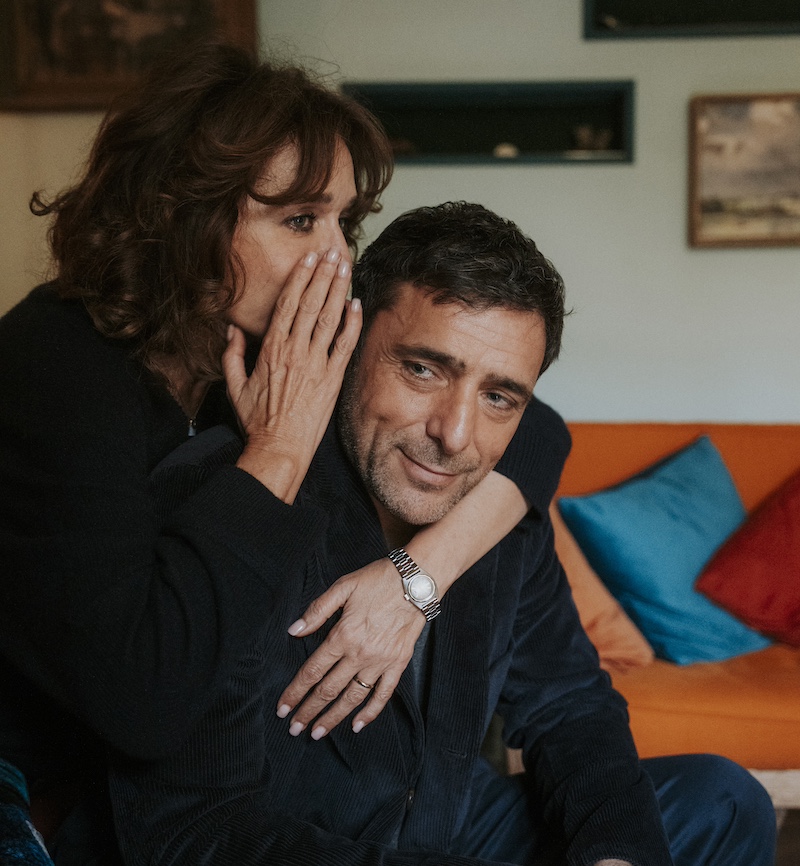
F.I. Absolutely. In the end, it looks like everyone is reaching their own catharsis, their own kind of resolution in a very unconventional and unexpected way. But equally what really stands out is the fact that they are walking down this path without being fully aware of it. Sometimes it seems that they know what they are becoming involved with. Other times they are discovering themselves through the process. What is also interesting is the fact that Cecilia is a psychoanalyst. Why is this lens of psychotherapy important to you?
L.R. To me, in life, yes! (laughs). And also, because I think that the job of the psychoanalyst is to welcome, to accept things, never judging. So, it was important for me to never judge the characters. Each one of them has a point of view on relationships, couples, etc, which is legitimate, I think. I might not agree with everyone, but they are legitimate. They are possible. And also, when they are all together in a room, I wanted the scene to have a flavour of a western, where there is the Mexican standoff. Everybody has a gun and since this is the case no one can shoot first. Everybody is guilty. There is no good or bad in this story. We are humans, flawed.
F.I. Also going back to the characters, they feel so real, so well-developed. Even the lady in the bar.
L.R. I love her! She is a great theatre actress.
F.I. She is so believable. She feels like a real person; a real Roman, not an actor.
L.R. Do you remember the film The Crying Game (Jordan, 1992)? There was the bartender who was always so critical in the plot. They talk to each other using the bartender. These scenes with the bartender always fascinated me and maybe I took something from that for the bar scenes, yeah. Now I realised it! (laughs). Thank you! I stole something from that film! (laughs).
F.I (laughs) It seemed very organic in the film as if the bartender jumps out of the city, which in itself serves as a character, in a way.
L.R. Yes. It is Rome. A contemporary setting but it could be anywhere in the world. So, present but it is also timeless and universal.
F..I. I have to ask you this final question about untranslatable words.
L.R. Meraki! (a Greek word that cannot be translated directly into other languages, but it roughly means the joy, passion, integrity and sophistication that one employs when making something). (Laughs). I made this film with a lot of meraki.
F.I (laughs). It shows! Where does this come from?
L.R. It is a passion of mine. But also, I love languages. You know the friend of Rocco and Cecilia has this relationship with his wife where at the beginning of the film they keep fighting, they cannot stand each other, but then when he experiences this health problem and he cannot talk properly they still find a way to understand one another. And I think that this was tender. Because I remember reading this thing that when we are with someone in a couple, we have our own secret language with them. We have nicknames, we have our own inside jokes. So, when a couple splits a language dies. It was something connected to the relationship. That’s what human beings do when they are together. They develop their own language.
F.I: This is beautiful! And in a way you created your own language with this film. A language that is expressed equally through the script but also the filmmaking, the cinematography, mise-en-scène.
L.R. Thank you so much. That’s the greatest thing you can say to a person, that they have created their own thing, their own language.
F.I. Thank you so much, it was a pleasure to meet you!
L.R. Kalispera! (Good evening in Greek).
F.I. Kalispera!
Interview to Eirini Nikopoulou
Info:
A Brief Affair (Breve Storia D’ Amore) (2025).
Written and Directed by Ludovica Rampoldi. Cast: Pilar Fogliati, Adriano Giannini, Andrea Carpenzano, Valeria Golino. Cinematographer: Gogo Bianchi. Editor: Francesca Calvelli. Year: 2025. Language: Italian. Runtime: 1h 38 minutes.